Posts Tagged ‘Words for Life’

The news on the street

Wednesday, May 2nd, 2012

The latest edition of Words for Life is out now. This edition features stories from the Philippines, Nigeria and right here in the UK. It’s also a brilliant way to find out the latest about previously mentioned issues, like Biblefresh and Wycliffe workers looking for support.

Meet Mary, whose life is changing as the word of God is beginning to reach her language group:

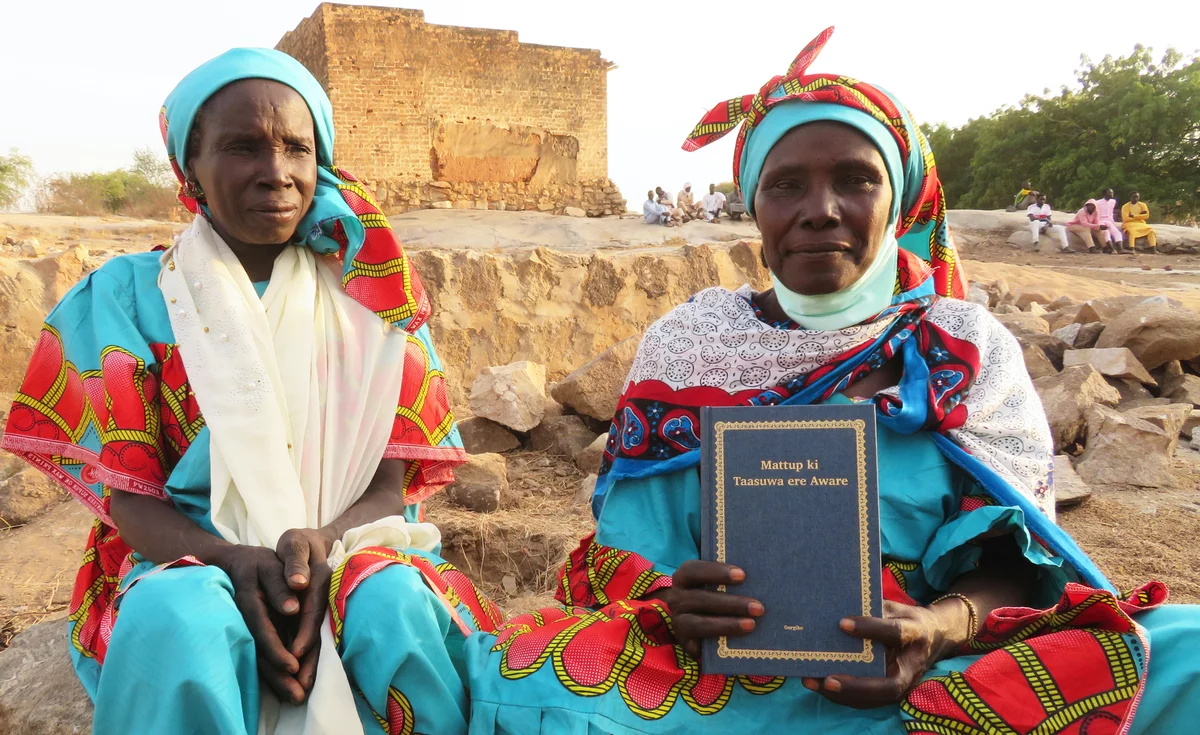
‘Mary Yusuf is possibly one of the busiest women I have met. While we sit quietly chatting through an interpreter in the corner of a church in the village of Zaron, she tells me of her various roles: housewife and mother of five, farmer, women’s worker, Sunday School teacher…

‘She sits with the first printed draft of John’s Gospel in Ichen, her language, on her lap. “This book has been a very big blessing for me,” she says, explaining how, having studied the Gospel, she was better equipped to lead the women and children. “I taught the prayer cell how to be doing the Lord’s Prayer – such that even the little children in their prayer cell can say the Lord’s Prayer in Ichen very very clear.”’

John’s Gospel in Mary’s language is helping her with more than preparing for church: it’s giving her hope for her family and community. Read it here.

And the newest Call to Prayer, our bi-monthly prayer diary is also out now.

Go to wycliffe.org.uk/subscriptions to sign up to receive Words for Life or Call to Prayer by email or post.

How far would you go?

Sunday, January 22nd, 2012

One of the stories in our latest magazine was about the astonishing transformation God worked among the Pinai-Hagahai when the word of God came to them. The translated Scriptures were distributed on solar-powered media players. Read what happened when one family’s media player broke…

"Scriptures in my language"

‘What would you be willing to do to hear God’s Word in your language? Would you hike for half a day? Would you cross a rugged mountain? Would you navigate a vine bridge suspended over a raging river?

‘That’s what Wapena Mei did in order to obtain a small solar-powered device that has a recording of Matthew, Mark, Luke, John and Acts in the Pinai-Hagahai language. You see, Wapena knew it would be worth the trip because he had already been listening to the oral Scriptures for more than a year. But when his family’s player broke and they learned that 70 more would be distributed in a village across the mountain, his wife gave him the charge, “Go and get us another one of those MegaVoice units.”

‘Wapena was successful in his mission and he and his wife Makome will again be able to listen to the Pinai-Hagahai Scriptures in their small dwelling as they go to sleep at night. Wapena also uses it as a resource to prepare sermons for preaching in area churches.’ Account by Karen Weaver. Read more on thewordislife.net.

You can read more about the initial response to the media players in our magazine, Words for Life.

Pinai-Hagahai is a language of Papua New Guinea, the country with the greatest need for Bible translation in the world. Wapena Mei can hear God’s word in his language, but many more in his country and around the world have never heard even a single verse. Share God’s Story.

Read all about it: new magazine out now

Monday, October 31st, 2011

The newest edition of Words for Life, our bi-annual magazine, is out now. It’s stuffed full of stories and photos about what’s been going on in Bible translation. Read more about revival among a people group in Papua New Guinea:

‘Because the Pinai-Hagahai live in such a remote area, there was a serious problem of lawlessness and crime when we started our work. Within months of our arrival in the language group, our village house was looted and destroyed, people were robbed, beaten, raped, and wounded, and the whole village was abandoned and burned down. The criminal activity in those days was so severe that I sometimes thought, “This is indeed a God-forsaken place.”

‘But God had neither forgotten nor abandoned his lost sheep.’ There’s much more to this story in Words for Life.

The newest edition of Call to Prayer is out now too. See the needs and rejoice in God’s provision for…

  • Murug, illiterate and selling chickens to support his 6 children, who listens to them read from Genesis in his language every night.
  • a Wycliffe Youth team, whose trip to Togo opened their eyes.
  • Seyidi, who has been sharing Bible stories in his language at the local market every week for more than two years.

Both Words for Life and Call to Prayer are available online. If you like what you see, you can sign up to receive them regularly by mail or email.

Words for Life and the Tradition of Bible Translation

Tuesday, May 3rd, 2011

Yesterday was the 400th centenary of the Authorised King James Version’s first publication. Four hundred years later, this version remains the most ubiquitous of all Bible translations.

The process of Bible translation is very different as it happens around the world today. Instead of tens of translators, work often goes on with just a couple. And where the KJB had monarchical approval, not everyone is as happy to welcome Bible translations in the mother-tongue.

Take Mumure, a translator for Guhu Samane:

When Mumure Ttopoqogo began working with linguist Ernie Richert, news of their work spread throughout the area. By the time they finished the translation, the Guhu Samane people were so anxious for God’s word that the initial printing of 1200 New Testaments sold out almost immediately and a second printing of 1600 copies sold out in just two weeks. Even those who didn’t read purchased a copy of the Bible to save for their children or grandchildren. The people believed in the power of that word.

The excitement of the Guhu Samane translation was catching. But the local church leaders rejected this work, and Mumure ended up in prison. But prison walls cannot restrain the power of God’s word…

The newest edition of the Wycliffe magazine Words for Life follows Mumure’s story, and records much more of what’s going on in Bible translation around the world. You can read it here.

Wycliffe International Day of Prayer

Tuesday, November 9th, 2010

“If people stop praying, there’s no point in us going back there. The battle is so fierce that unless you have an army of prayers and supporters behind you, you don’t stand a chance.”

Theresa’s thoughts on translating the Bible in a nominally Christian group of islands in Papua New Guinea.  Read more of her story here.

Wycliffe have held an annual day of prayer for the past fifty years.  Today we have another chance to partner together, praying that we would see people from every nation, tribe and tongue reading and believing God’s word.

The scope of our prayers is huge: praying for missionaries, for ongoing translation projects, for people who do not yet have the Scriptures, as well as for those who already have them.

If you’d like to join in with praying for what God is doing around the world there are several ways you can do this:

Find out more about how you can be involved with the ongoing work of Bible translation.

Transformed hearts, transformed lives

Friday, July 9th, 2010

Dave Pearson, Language Development Advocate, helps UN agencies and NGOs to better integrate language issues into their development work.  His article, which was first published in the May 2010 Issue of Wycliffe Bible Translators’ UK magazine Words for Life, powerfully illustrates the impact of literacy programmes in areas where Wycliffe are at work.

Information Poverty Kills!

Woman with baby in literacy class, AfricaAnée wept bitterly as she held her baby close to her chest. She was filled with a confusion of anger, grief and guilt. She was supposed to have taken the medicine herself and the baby would have benefitted through her milk. But she didn’t understand the doctor’s instructions, and she can’t read, so she gave the medicine directly to her baby. Her newborn daughter died from a tragic and avoidable overdose. Information poverty kills.

Anée was the wife of our night guard, Beltoise when we lived in Chad. Their angry grief made me angry too. The doctor should have known that 80% of Chadian women are illiterate. He should have known that she probably needed to be told what to do. Anée had been to primary school, but since everything was in French she had understood so little that by the time she left she was still unable to read. Children who learn to read and write in their mother tongue before bridging to the official language flourish and fly, while those who have to do it all in French often flounder and fail. It still troubles me that while in the UK only six children out of 1,000 live births die before the age of five, in Chad it’s 200 children. So many of those deaths are avoidable. There is a direct link between mothers being able to read and infant mortality. Mothers who can read have children who live longer.

Hope for the future

But there is hope! The Chadian government is starting to explore teaching in the mother tongue in primary school. They are also promoting the use of Chadian languages for adult literacy. But that can’t happen without the right resources. For decades Wycliffe staff have been analysing languages and producing guides to understanding grammar, dictionaries and literacy materials. These are essential to good Bible translation, but they are invaluable for multilingual schools too.

Our work in many developing countries is not only enabling people to find spiritual healing and nourishment, but physical healing and nourishment too. One of the booklets our teams translated into several languages of Chad was a very simple guide on how to treat a baby with diarrhoea. It’s so simple: sterile water, salt and sugar can save the life of a sick child. In the 15 years since it was translated that little booklet has probably saved hundreds of lives. To quote Nobel Prize winner Sir William Lewis “The fundamental cure for poverty is not money but knowledge”.

The pendulum effect

I really enjoyed watching Alice in Wonderland at the cinema with my wife and children earlier this year. “Contrariwise” said Tweedledee as he bickered with Tweedledum. Two people contradicting each other just for the sake of it makes for entertaining comedy, but it’s a disastrous way to develop theology. Somebody overstates their case, so somebody else feels the need to counter that position by overstating an opposing view. Before long we have polarised an argument into two unbiblical, but firmly-held positions.

Parts of the church have done this with evangelism and social action, promoting one to the exclusion of the other. This was starkly illustrated last month by an American TV show host who encouraged Christians to leave churches that worked for “social justice” because he believed it to be just a code for “communism”! Any church that treats a person as either just-a-soul-that-needs-saving, or just-a-body-that- needs-feeding has definitely lost the plot. Jesus both taught and fed the five thousand.

Wycliffe’s Integral Mission

Wycliffe Bible Translators in the UK is a member of an international family of organisations called Wycliffe Bible Translators International (WBTI). WBTI is a member of the Micah Network, a group of over 300 Christian agencies committed to Integral Mission. Integral mission is “the proclamation and demonstration of the gospel. It is not simply that evangelism and social involvement are to be done alongside each other. Rather, in integral mission our proclamation has social consequences as we call people to love and repentance in all areas of life. And our social involvement has evangelistic consequences as we bear witness to the transforming grace of Jesus Christ. If we ignore the world we betray the word of God which sends us out to serve the world. If we ignore the word of God we have nothing to bring to the world. Justice and justification by faith, worship and political action, the spiritual and the material, personal change and structural change belong together.” (micahnetwork.org).

Wycliffe’s language development work produces transformed lives through the translated Word and through translated development information. People grow better crops and live better lives. They care for their environment and they care for their neighbours. They learn about justification by faith and oral rehydration solution. Wycliffe’s work brings both spiritual and material blessing.

Development agencies such as World Vision and Save the Children are increasingly paying attention to these issues. My current role involves working with such agencies to help them better understand the roles culture and language can play in development. So is Wycliffe becoming a development agency? No, our core purpose is still clearly in focus, but we are not blind to the broader consequences of our work. Language development is holistic ministry, meeting the needs of people who still have both body and soul.

Dave Pearson was Director of the Chad Branch of SIL from 1991 to 1998. He currently serves as a Language Development Advocate, helping UN agencies and NGOs to better integrate language issues into their development work.

Article first published in the May 2010 Issue of Wycliffe Bible Translators’ UK magazine “Words for Life” .

Find out more about working as a literacy specialist with Wycliffe, or check out the new MA Literacy Programme Development.


Wycliffe World Day of Prayer

Friday, November 20th, 2009

Last week was Wycliffe’s annual worldwide day of prayer, where thousands of people involved in Bible translation around the world take a day to pray and listen to where God might be leading us. Here in the UK we spent time praying for language communities around the world, and then lifted up ourselves and how God would have us be involved in the UK.


Praying for South America

If you’d like to join in with praying for what God is doing around the world there are several ways to do this:

Our prayer is that as you bring these things before God you will be encouraged and excited as we are by the privilege of playing a small part in what God is doing translating his message of love into languages and lives!