Northwest Cameroon is not an easy place to live. For the last decade, communities there have been caught up in civil unrest. People face constant insecurity.
And yet, despite the chaos and danger, God has been at work.
And he continues to work!
And yet, despite the chaos and danger, God has been at work.
And he continues to work!
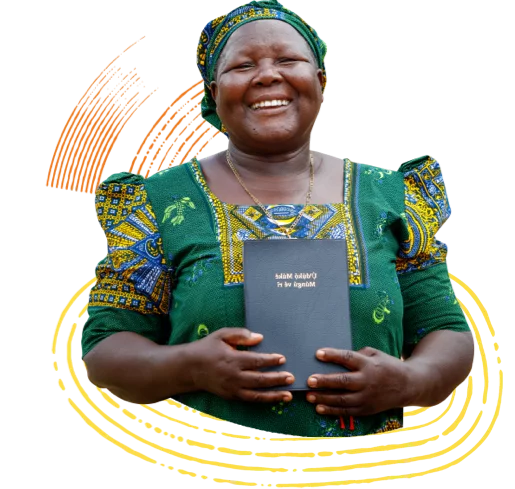
 The Bamunka New Testament is presented to the people
 Nowhere more so than among the Bamunka people, who celebrated the launch of the New Testament in their language, Ŋgieməkɔʼkə (also spelt Ngiemekohke, and pronounced Ngyey-ma-ko-ka), early in 2026.
Their towns and villages might be within the conflict zone, but the Bible translation team and the community have worked tirelessly and courageously to complete their New Testament.
Even though the team and community have been forced to adapt to evacuations, the Covid pandemic and remote working, they have persisted valiantly.
Now, 19 years after starting the translation work, they have the New Testament in their language!
The main launch day was on 14 February 2026, and held in Bafoussam, a large town in the West region, because of the ongoing security issues.
 Reciting the memorised New Testament
 But such was the determination of the community, they held a smaller launch day in the heart of the Bamunka area on 14 January 2026.
There were plenty of highlights.
One in particular was some of the children reciting memory verses and reading passages from the Bamunka New Testament. They also took part in a short competition to write a dictated verse (John 3:16) in the language.
In addition, some of the songs were performed in the Ngiemekohke language.
 People from all denominations joined together for the day
 As Appolinaire Ambassa, leader of our main partner organisation in Cameroon and one of the speakers at the launch, announced:
‘God speaks Bamunka!’
There was a buzz of excitement – about the day, but also about what it meant.
Lucha Johnson said at the launch event:
‘I am here on behalf of the village of Bamunka [the main village of the Bamunka people]. When we heard about the New Testament in our language, we were so thankful. We knew we couldn’t stay indifferent, so that is why as a group we have ordered 90 copies so we can share it with the people of the village, in all the meetings of the Bamunka people, and wherever a Bamunka person is, so that they can read it.’
Lucha’s enthusiasm – not just to attend the event in Bafoussam, but also to ensure all his community have an opportunity to read and hear God’s word in their language – is an example of just how the community is embracing this historic moment.
 Taking part in the competition to write John 3:16
 Because it’s not just about the launch itself: it’s about what it signifies.
First and foremost, the whole Bamunka community can hear and read what Jesus has done for them in the language that speaks to them best.
Through this, people are coming to faith.
People like Martina. Daniel, who is the Bamunka literacy supervisor, says:
 Sisters in arms: Martina and Jane (right, serving with Wycliffe)
 ‘Martina wasn’t a Christian before joining an adult literacy class for people who don’t read English. But she completed the class, and has given her life to Christ.
‘She is reading from the Bamunka New Testament in her church. This was a big challenge to the pastor, and he decided to join an adult literacy class for people who can read English, and now he is preaching in his mother tongue using the Bamunka New Testament.
‘Martina now does devotions with her family. She reads a few verses from the Bamunka New Testament, and the family meditates on it.’
 Pastor Edward
 Pastor Edward Woghombong, one of the Bamunka church leaders, comments:
‘Whenever I have an opportunity to share the word of God anywhere in the village, I read from my mother-tongue New Testament.
‘Usually it attracts people’s attention more than reading from English.’
Another church leader, Rev Magellan, comments:
‘The Bamunka people in my church listen more and are more receptive when the word of God is being shared in their language.’
Pastor Edward says:
 Reading publicly from the Bamunka New Testament
 ‘With the coming of the Bamunka New Testament, people are getting more serious about learning the language and trying to be intentional in speaking.
‘At first, people spoke the language anyhow, without caring about the constructions and pronunciations of words, but now people are challenged to think before speaking.’
He continues:
‘We are trying to introduce multilingual studies in the primary school. That is going to help children who experience such learning to grow in their knowledge of their language.’
Jane Ingle serves with Wycliffe and worked on the Bamunka New Testament for many years. She attended the launch and comments:
 A child writes John 3:16 in the Bamunka language competition
 ‘As children assembled at the front to recite their memory verse and read from Scripture, their enthusiasm was very evident and very moving! It was also a joy to see children eager to write Ngiemekohke. As I was involved in developing a system for writing the tones in the language, I noticed that they were already writing well and using the tone marks well!
‘This excitement among the young generation has prompted me to be praying continually for mother-tongue teaching in schools, for more literacy teachers to volunteer in the community, and for these children, who are the future Bamunka Church.’