Serve in Bible translation
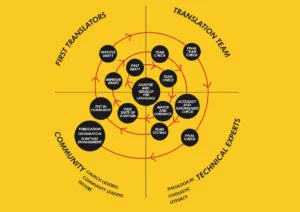
‘Translation is a team effort. The complex task of translating the Bible interweaves stages of drafting, checking, revising, more checking, and more revising, until an accurate, clear and natural translation is complete.’
David Rowbory, Bible translation consultant
David Rowbory is a translation consultant serving with Wycliffe. He teaches translation and works with Ashe translators in Nigeria, and has developed this spiral diagram to illustrate the stages of the Bible translation process, as well as who is involved at each stage:
David works in partnership with local Ashe translators. He says: ‘I want to help the translators understand more of the riches of their language and get better at understanding the Bible and putting it into the words of their own language.’
Translation consultants face intellectual, physical, emotional and spiritual challenges as they bring God’s word to people who have never heard or understood it.
Skills and experience for translation roles
The School of Language and Scripture provides training for translation roles. Generally, successful participation in a translation programme will require:
- a good knowledge of the local language and culture;
- commitment to identifying gifted local translators and training them to participate fully in the task;
- a thorough understanding of the Scriptures, so that the original message can be communicated clearly in the local language;
- careful checking of the translation work to make sure it communicates accurately, clearly and naturally;
- interaction with church leaders and government officials to encourage ongoing support for the programme.
People involved in translation often learn the language and culture of a group by living with people and taking time to build relationships. So they would normally serve in partnership with local speakers of the language.
Exegetes
Another important part of the translation process is exegetics – that is, analysing the meaning of the biblical text. Thus exegetes provide valuable support to Bible translators, enabling them to make sure the translation communicates the meaning well. Usually exegetical work is carried out through one of Wycliffe’s partner organisations, SIL International, and often in partnership with other national and international Bible translation organisations.
Skills and experience for exegetes
Applicants for exegetical work:
- are usually educated to degree level
- have a good understanding of the Scriptures (often with some formal Bible training)
- enjoy working with people.
We would love to talk to you about serving God through translation.
Header photo: Keliko translator Isaac Kenyi reads from the Keliko New Testament. Read about the launch of the Keliko New Testament here.