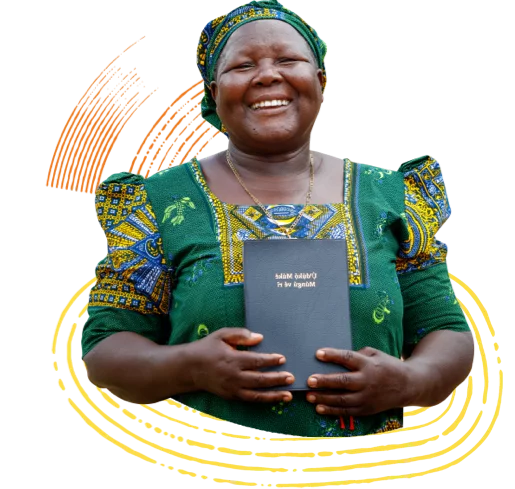
It’s celebration time!

Today we can announce that the Bible has been launched in its 800th translated language!

This is an amazing milestone in the history of Bible translation. It means around 6.2 billion people in 800 language communities* now have the complete Bible in their own languages.

Image of a graph showing the number of languages with the whole Bible translated each year since 1800

Acceleration

The 800 milestone is indicative of the remarkable momentum apparent across the world of Bible translation. As the graph vividly shows, there has been tremendous acceleration in translating the whole Bible into languages that, until now, have not had it. And the momentum is currently increasing! (This acceleration is reflected in the translations of New Testaments and portions of Scripture too.)

Image of an infographic saying 'x2 – doubled since 1998 – the number of languages that have the whole Bible translated'

Let these facts sink in:

  • The number of languages that have the whole Bible translated has doubled since 1998.
  • It took over 1,900 years to translate the Bible into 400 languages, but just 28 years for the next 400 to have the Bible in their languages.
  • It is only six years ago that we were celebrating the Bible in the 700th language.
  • With these last 100 translations, 500 million more people have access to the complete Bible now than in 2020.
Image of an infographic saying '28 years – 1,900 years to translate the Bible into 400 languages, just 28 for the next 400'

These figures represent a wonderful and unparallelled team effort – first and foremost, by the local translation teams and their communities.

But also through the prayers and giving of supporters like you, the support of outside agencies and experts, plus advances in technology and knowledge. God’s word is being unlocked for every heart.

An extraordinary moment in world mission

James Poole, Wycliffe’s executive director, says:

‘This is an extraordinary time for world mission. Over recent decades we have seen remarkable progress, with translation work accelerating in many parts of the world. Communities are receiving the Bible far sooner than would have seemed possible only a generation ago.

Image of a man holding an oversized Ellomwe Bible at the head of a procession on its launch day in Malawi in 2020 We celebrated the 700th Bible just six years ago, in 2020, focusing on the Ellomwe people of Malawi

‘That matters because it means people are gaining access to God’s word in languages they understand deeply and naturally. As churches engage with the Scriptures in their own languages, they are better equipped for evangelism, discipleship and ministry.

‘We are witnessing God at work: this is a historic opportunity, and it is a privilege to play a part in what he is doing.’

1 in 800

One of the most recent newly translated Bibles is for the Podoko people of north Cameroon. Theirs is not a printed Bible; rather, it is available via the Digital Bible Library app – like a number of others.

Image of Podoko people dancing at an event in north Cameroon The Podoko people got the Bible in their language recently (Image: Desy Danga, CC0, via Wikimedia Commons)

It means the Podoko people can now access all of God’s word in the language they understand best. God’s word in digital form can permeate the Podoko community, where there are very few believers, opportunities for traditional evangelism are scarce, and physical access is difficult.

Transformation

‘Celebrating the 800th completed Bible translation is very exciting, of course,’ says James.

‘But more significant than the number itself is what it represents. Millions more people are now able to engage with the whole Bible in the language that speaks to them best, often for the first time.’

Image of Kaleb Edoh, Bible translator with the Ifè programme in Togo and Benin, seated at his computer doing Bible translation work Kaleb Edoh working on the Ifè Scriptures

Kaleb Edoh led the Ifè Bible translation team in Togo and Benin until his death last year.

After the New Testament had been translated and launched into the Ifè language in 2009, he recognised the importance of continuing the translation work until the whole Bible was available in his Ifè language:

‘There are many stories in the Old Testament which help us understand the New Testament. The sacrifices written about in the Old Testament are very similar to the animist sacrifices done in traditional Ifè life. Reading what Leviticus has to say about sacrifices will help our people to understand what they were before coming to Christ, and how they have changed since.

‘So it is very important for our people to have all of the Bible translated into Ifè.’

Translation of the Ifè Bible is due to be completed in the next few years.

‘For the Ifè people, having the whole Bible will have a profound impact,’ continues James.

Image of an infographic saying '6 years since we celebrated the Bible in the 700th language'

‘The availability of the whole Bible creates new opportunities for churches and Christians to engage with God’s word more fully as it is unlocked for every heart. As people encounter the Scriptures more deeply, they are better able to understand God’s character, Christ’s work, and the hope of the gospel. Over time, that shapes lives, strengthens churches and bears fruit in communities – creating new pathways to hope.’

1 in 5 still waiting

Despite the progress represented by the 800th Bible, however, there is still much work to be done. Although the 800th Bible is a major milestone, and means that four-fifths of the world population have the Bible in their language, the fact remains that 1 in 5 people still do not have the Bible in their language. That’s about 1.5 billion people and just under 6,600 languages without the Bible! (There are 7,393 languages in total.)

But the good news is that there is more translation work happening then ever before, and so the huge leap forward represented by the 800th Bible is set to continue in the coming years.

Image of an infographic saying '500 million more people have the Bible in their language than when the 700th Bible was launched'

James concludes: ‘As we join in the celebrations for the 800th Bible, at the same time we remember the 1 in 5 people worldwide who do not yet have access to the Bible in the language that serves them best. So alongside our gratitude for what has been achieved, there remains a sense of urgency. Every language represents people whom God loves. That is why we continue to work with Christians and churches around the world as they seek to make God’s word accessible to their communities.’

If you are interested in getting involved in all that God is doing through the ministry of Bible translation, you can do so through giving, praying, joining or simply being informed. Click on each word to find out more.


*All statistics provided by ProgressBible, progress.bible

Story by: Jeremy Weightman

Wycliffe Bible Translators logo Close
Close modal