Posts Tagged ‘Tanzania’

How many?

Sunday, February 24th, 2013

Mark and Richard are working in Tanzania with a group of languages. After they reported to local pastors on the progress of writing down two of the languages in preparation for Bible translation, the conversation soon turned to numbers:

‘How many Pimbwe [people] are there?’ asked one of the more senior leaders.

Richard answered that there are only about 20,000 Pimbwe according to our estimates, but that we still believe there is value in translating the Bible because of the impact that local language Scriptures can have in the life of the community, even if the language is only spoken in a few villages.

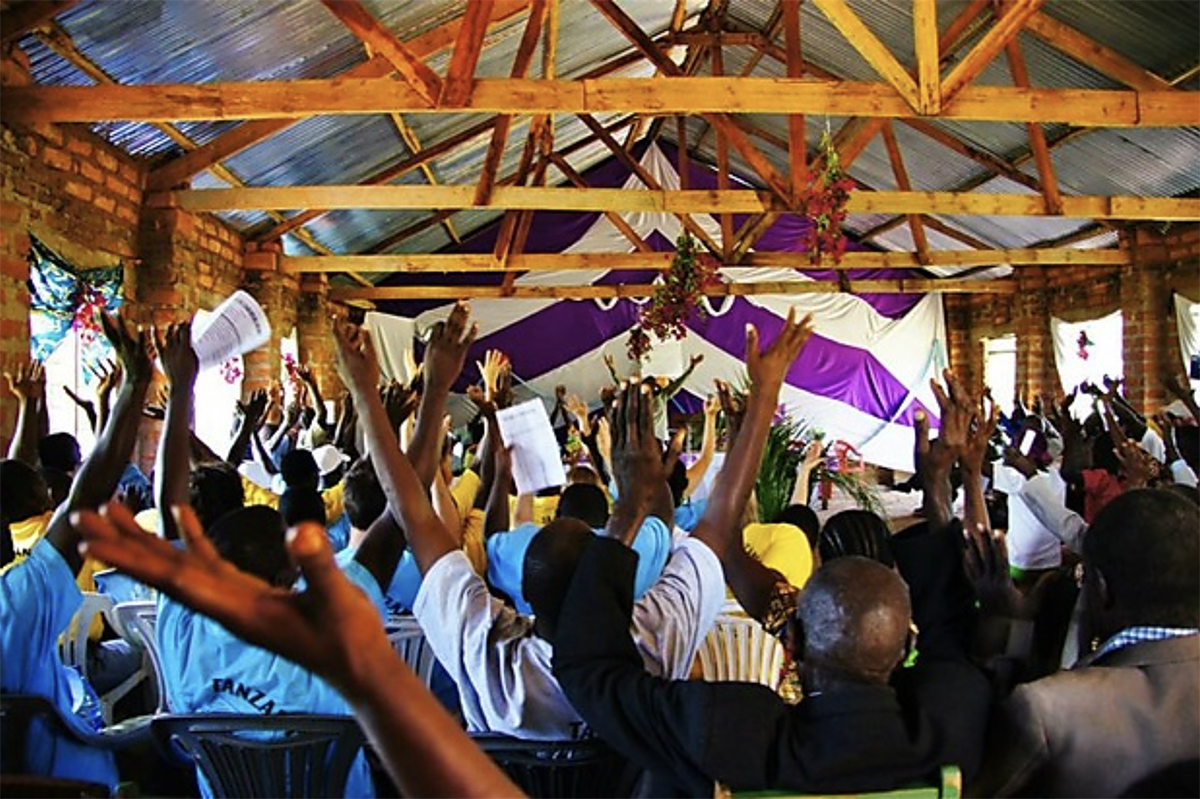
A church building in TanzaniaWe looked up, expecting the pastor to be sceptical, or to advise that our resources could be better used elsewhere. But no… instead he encouraged us.

‘I want to encourage you that this is a work from God,’ he said. ‘When Jesus healed the man with the evil spirits, he ended up sending them into a large herd of pigs who then charged off the hill and drowned. This herd of pigs was the project of the whole village, and they depended on the business the pigs generated. But Jesus cared more about the life of one person than he did about the business project of the entire village.’

He continued, ‘He probably should have been arrested right there, for destroying their business! But the point was that Jesus valued the life of this one man more than the wealth of the entire village. So I want to tell you not to become discouraged because there are few speakers, but rather be joyful that God cares even for a small group like the Pimbwe, and that this is a work of God!’

This report of encourgement comes from Mark Woodward’s blog.

Translating God’s word is a way of showing Jesus’s love to even the smallest communities. Nearly 2,000 language groups are still without a single verse of Scripture or a project started to translate it. Give God’s Story.

Why translate the Bible into Bende?

Thursday, January 31st, 2013

Translating the Bible into a language in which there has never been Scripture before is not a short activity. A lot of work is needed even before translation begins. For the Bende translation project in Tanzania, that work is just getting underway. This report comes from the end of last year:

Two Tanzanians read a Bible together at a tableWe were excited to be able to host six speakers of the Bende language, as they took the very first step towards writing their language and later starting to translate the Bible into Bende. During the week that they spent with us they managed to collect nearly 2,000 words in their language, which will later be analysed linguistically to come up with a writing system that is intuitive and easy for Bende speakers to read and write.

There are many steps still to go, but these Bende speakers are looking to the impact of the final Bible translation, the first in Bende:

At the end of the workshop I asked the participants what benefit they personally would envisage from having the Bible available in their language. Here’s what they said:

The benefits would be many, not just one, because there are some things that are written in Swahili that the Bende are unable to read. Some words, for example ‘king’. When they say that Jesus is king, they don’t know that Jesus is their king; they often say that they don’t understand. Because of this, people say, ‘It is better for us to return to our traditional practices, because we don’t understand these things.’

But if we were to have the Bible written in Bende we would be very happy, and we would read it and understand it, even the old people. So our request, from our point of view, would be that this ministry would reach out to us Bende people, in order that it help us in our lives.

Bende is just one of around 2,000 languages where translation work has only just begun or still not started, and where having a Bible is not just a desire, but a necessity for them to grow in their knowledge and love of God. You can help more people get God’s word!

This account was first published on thetask.net.

Sold out!

Thursday, December 27th, 2012

Many of us will be happily taking a rest, after battling our way through last-minute Christmas panics, hundreds of carol services and a substantial Christmas meal. And, as is traditional, many of us will choose to spend our well-earned rest fighting our way through the post-Christmas sales.

This account, from Tanzania, provides a bit of a contrast to sale shopping in the UK. (When was the last time you found Bibles sold out in your local bookshop?!)

Image used for illustarive purposes only. By Heather Pubols.This morning, I was told by one of my colleagues that he tried to get a copy of the book of Ruth in the Safwa language, but it was sold out. ‘Good news,’ I thought, ‘all 100 copies that were printed have already been sold out.’

I was so glad to hear that. We asked our colleagues, who usually print books for us, for more copies of Safwa Ruth. Slowly it became clear during our conversation, that they printed 400 more copies in October. So, in total, there were not only 100 copies sold, as I first thought, but almost 500! I knew that the Safwa people were waiting for God’s word in their language for several years and that they were excited about the first Biblical book in Safwa, Ruth, but not one of us expected so many copies to be sold in just over half a year! God is great!

This story is originally from thetask.net, where you can find lots more inspiration about the work in Tanzania and Uganda.

Give the gift of God’s word.

The ‘boring’ objection

Thursday, November 8th, 2012

For some people, translating the Bible is not an exciting concept. People carry around all sorts of misconceptions about the Bible as something that they had to hear about in a dull Sunday school, full of irrelevant and boring stories. One translator in Tanzania went out to test the newly translated book of Ruth with some people who thought like this. Their response blew the ‘boring’ objection away:

An Ikoma woman with the newly published book of Luke.

After completing the initial draft of the book of Ruth, Mussa, one of the Ikoma translators, went out to a village to read it aloud to see what the community thought of it. He had called ahead and asked a man he knew who lived in that village to prepare a group of ten people to be ready to listen and provide feedback on the translation. But when he arrived, a significantly larger group, comprised of some Christians and some non-Christians, was waiting, curious and eager to take part!

After reading two chapters of Ruth, several of the non-Christians in the group spoke up. They said, ‘This is such a good story! We didn’t know the Bible had good stories in it!

Mussa answered that the Bible had many excellent stories in it, and that someday many of the stories will be translated into the Ikoma language, so they can read them all they like in their mother tongue. He had not planned on doing evangelism when he went out to the village to test the Ruth translation, but it seems a few small seeds of interest were planted that day.

Do you ever feel the ‘boring’ objection creeping up on you? Take a look at this brilliant video from Scripture Union or explore our A to Z of ways to get back into God’s fantastically exciting word.

Photo by Michael Nicholls. This account is from thetask.net, which is all about Bible translation in Uganda and Tanzania.

Creating alphabets

Monday, September 24th, 2012

People will believe that God knows them if their language has Scripture in it… they will be very happy!‘ This was the opinion of Stephen, a speaker of the Bende language in Tanzania’s Katavi Region. But in order for parts of the Bible to be written in a language, there must first be an alphabet that is easy and intuitive for speakers of the language to read.

It was this task of creating suitable alphabets that brought Stephen and seven other speakers of the Bende and Pimbwe languages together for a three-week workshop that finished last Friday. Led by three of our colleagues who came alongside and guided them through the linguistic analysis, the participants painstakingly studied the sounds that make up the language they speak every day, in order to discover how they function together to make words.

Once the sounds had been analysed, the linguists were able to make recommendations to Stephen and the other Bende and Pimbwe speakers as to how their languages might best be written in ways that reflect the perceptions of the speakers, and hence are intuitive to read and write. Together they were then able to come up with tentative orthographies, or writing systems, that will now be tested and refined over the coming months.

The participants left the workshop with the provisional alphabet charts they had helped create, along with the satisfaction of knowing that they had achieved something that had never before been done in their language community. As Bende and Pimbwe speakers from western Tanzania, together with linguistic experts from around the world, they had created a writing system, and in the process taken one step closer to seeing the first books and Scripture portions produced in the languages of the Bende and Pimbwe peoples.

This blog post and the photos are by Mark Woodward, a Wycliffe worker based in Tanzania. Read more from him on his blog, everytongue.co.uk.

First taste

Tuesday, July 17th, 2012

Translating God’s word is not only an academic or linguistic exercise. As national translators are the first people to have God’s word in their mother tongue, they have the first glimpse of the impact the Scriptures will have among speakers of their language.

In this video from Wycliffe USA, Samuel shares how translating the Scriptures has transformed the way that he understands them. Samuel works with the Uganda-Tanzania branch of Wycliffe’s key partner, SIL.

For more stories from the work in Uganda and Tanzania, visit the branch website, thetask.net. Find out more about the need for the Bible to be translated into the mother-tongue languages of people everywhere.

Giving a goat for God’s word

Saturday, May 26th, 2012

Many of the language communities are marginalised economically as well as spiritually: some might not have national recognition or access to an equal education. But that doesn’t stop the celebrations when God’s word comes:

We weren’t sure what to expect. The Kabwa language group [in Tanzania] is the smallest of the nine groups the Mara Cluster Project* is working on Bible translation with. And they are also one of the poorest. So, in planning for a Scripture dedication event, we were worried that they would struggle to accomplish the full Tanzanian-style celebration that they were hoping for.

At the very first planning meeting for the dedication event people quickly began pledging goats and cash with enthusiasm. The deep passion for their language was so visible on that day, you couldn’t miss it. It was apparent that, if any people group is going to embrace mother-tongue Scripture, Kabwa is likely going to be one of them.

Kabwa people gathered in the small village of Kirumi and dedicated some special green books, the Gospel of Luke in Kabwa. The entire day was full of joy, and it was a thrill to watch the small crowd of people at the beginning of the day grow to become enough to pack the little Anglican church.

Unfortunately, we were only able to bring a limited supply of Luke books on that day. A few minutes after the box was opened during the ceremony, flashes of green could be seen around the church building. The books were sold out within minutes!

You can read more about the Mara Cluster Project and Bible translation in Uganda and Tanzania at thetask.net, the source of this account. Help start celebrations around the world by supporting the work of Bible translation. Give God’s Story.

*A cluster project is a Bible translation project that serves more than one language. The languages are generally geographically or linguistically related.

Survival of the weakest

Tuesday, May 15th, 2012

A recent BBC article reported on a study linking biodiversity and the diversity of languages. It also pointed out that for both languages and species, the risk of extinction is increasing. It got Mark (in Tanzania working with Wycliffe) thinking…

One response is say that languages, and to a lesser extent plants and animals, only have value in the degree to which they are useful to us, and so there is little reason to mourn their loss. In fact, in the case of languages, the reduction in diversity can actually make the task of communication easier, so the loss of languages may even be welcomed.

But I would suggest that a pragmatic view that only sees species and languages as having value based on their usefulness to us doesn’t do justice to God’s creativity and his instruction to humanity to be good stewards of his creation. Plants and animals are valuable simply because God created them, and because he said they were good. Similarly, languages are valuable because they are also part of God’s diverse creation, and are spoken by people who are of great worth.

In God’s kingdom every person has value and is to be treated with love and respect. Whereas it can be tempting for us to measure the value of something based merely on what it can do or produce, or its financial worth, the way of Jesus is to leave everything in order to search for the the lost son, the lost sheep and the lost coin. In a world that preaches survival of the fittest, the life and death of Jesus shows a different way, where everything is given up in order to enable the thriving of the weakest.

In this light I believe a Christian response is to come alongside communities whose languages are threatened by extinction and offer our help in preserving and developing these languages, thereby allowing often struggling communities to thrive, affirming their identity, self-worth and their place in God’s world…


On a recent trip to the Pimbwe language area (photos) we were reminded of God’s creativity expressed both biologically and linguistically. Our prayer is that just as the national park we drove through on the way causes us to rejoice in God’s creation by preserving and celebrating some of these incredible animals, so our work alongside communities like the Pimbwe may allow them and others to praise God in and through their unique languages.

You can read more from Mark on his blog.

Pure Zanaki… sweet to hear!

Monday, March 12th, 2012

“When we finished drafting chapters 12-20 of Genesis, we traveled to a small Zanaki village named Mirwa to read the chapters aloud to people and see if they understood them or not and to get help with a few difficult words.” Find out more about the trip to Mirwa, Tanzania…

“In Mirwa, we were fortunate to have a large group of people, mostly non-Christians, who wanted to listen to the stories about Abraham.

“The group was very quiet when we were reading, except sometimes they’d tell us to go back and read a paragraph again, not because they hadn’t understood, but just because they liked it so much they wanted to hear it again! When we finished reading, they exclaimed, ‘We thought people weren’t speaking pure Zanaki anymore, and that people in town and young people were starting to look down on our language and to prefer Swahili, but here you are reading such good Zanaki! We’re so glad to hear our language being used so well, just the way it really is.’

“A few of the older people in the group said, ‘Long ago we heard a Christian pastor read to us from the gospel of Matthew, which was the only book of the Bible translated into Zanaki. We thought that when that project ended after just one book, nobody would ever write in Zanaki again. Thank you for your work to remember our language and to write it!  We are not Christians, but we think you are doing good work to translate the Bible. These are good stories and the way you have written them in such pure Zanaki…ah, that is sweet to hear.’ ” Story by Misha S.

This account comes from some of our partners working in Uganda and Tanzania. They share stories about the excitement of translating God’s word at TheTask.net.

Wycliffe workers are working in 6 languages in Uganda and 26 in Tanzania. Find out about some of the many roles there and around the world that still need filling for every language to have the Bible.

Gift giving

Saturday, December 10th, 2011

As well as having links to lots of Christmas resources you can use, we have also collected some stories. These stories speak specifically about how the Christmas story in the mother language had an impact on people’s understandings about Christmas and Jesus.

Take Pastor Waynse, a Simbiti translator from Tanzania. On his way to distribute the Nativity story to Simbiti speakers, he found another opportunity to share God’s Story:

“To reach the Simbiti villages I must board a small boat that ferries passengers across the lake. About 45 minutes into the trip, I began my work for the Lord. I called everyone’s attention in the boat and began to explain to them that God could speak their language. I told them about my work in the ministry of Bible translation for my own people group, the Simbiti.

“I pulled out a copy of the new Luke translation and began to read it. People crowded around to listen, and one woman purchased a copy on the spot. She was so happy and told me to press on in the work!”

Find out what happened to Pastor Waynse when he reached his destination, and read more stories on our Christmas resources page.

These collected stories make a short but thought-provoking addition to an advent service or small group social event. Reading them for ourselves can help us to be thankful for the gift of God’s word in our own language, and to pray for those who have never heard the Christmas story in a way they understand.

Make giving God’s Story to the 350 million who have no access part of your gift-giving this Christmas.